Thursday, May 24, 2007

Travel: Big and Small, pt. 4


Upon spending even a day wandering other northeastern US cities (for our purposes, say... Philadelphia and Manhattan), your average white resident of the District is hard-pressed to miss the relief into which DC's apartheid structure is rather clearly drawn. Stroll through Thompkins Square Park (or any other public space in lower Manhattan, for that matter) and you're immediately left counting -- on one hand, mind you -- the spaces in which one might be likely to see black families doing their thing within any proximity whatsoever to white families in DC (areas of NW between Florida Ave. and Oak St. offer some minor exception, with regard to Latino/White encounters; not without their own troubling contradictions).

None of this is to idealize such relations in the aforementioned cities; one needn't scroll back terribly far in even the mainstream headlines to locate the last time an innocent black male was riddled with four clips worth of police issue in NYC, and Philly's just now getting around to raising an eyebrow at its current state governor's role (as DA, in the 80's) in exercising nearly 2/3 of his jury-selection dismissals to remove black jurors from the prosecution of a certain black journalist (to say nothing of sworn testimony from a court stenographer that the judge in said case was overheard -- during recess -- relaying that he was about to "help fry a nigger"). Prison statistics being what they are in the US, we're blanketed in the shit, location be damned. Nonetheless, the contrast is stark. After some eleven years in the District, I'm not aware of any such public encounters; any such tangible indication that the lives of whites and the majority of black folks in DC so much as resemble each other or entail comparable aspirations. The neighborhoods that do presently offer up such routine encounters are almost exclusively those blessed with the euphemism of transition, and the encounters therein rarely stray from par for that particular course, nearest the casual observer can discern.

On some level, I suppose one could draw comfort from the apparently exceptional place DC holds in this regard; it lends itself to (at least) the daydream that this clusterfuck is not necessarily insurmountable. There are places that have not quite drifted into the uniquely sustained and brutal war on dignity overseen in our fair city... It's feasible that, buried somewhere within those places, one might come across some semblance of a bread trail back to something marginally less crushing. On another, It seems each passing minute sees the city further structurally outfitted against any such possibility, with skylines that stifle whatever fleeting thoughts one might entertain as to the value of what they've displaced. And no one's laughed out of the room (or strung up by their thumbs) when talk of "Redeeming the Dream" accompanies "commercial revitalization" and the emptying of the neighborhoods that went up in flames when King got popped.

Restraint begins to feel like sacrilege. And maybe it should.

Something akin to that surfaced in me, reading that the exhibit on The Disappeared had been declined by every major museum in the US, finding its only home at El Museo del Barrio. Even for people conscious of them -- people involved in solidarity movements, even -- eras like the not-so-long-gone military dictatorships of Latin America are often enough understood as distant abstractions -- near speculative legend, even -- despite that their atrocities reached such scale as to make the evening news hum of our childhoods, and despite that our country was as much responsible for them as it is the occupations of Iraq and Palestine, the invasions of Lebanon and Somalia, and the steadily unraveling scandal of State-sponsored rightwing death squads in Colombia.

Moreover, given what a comeback the practice of disappearing "persons of interest" has seen under the Bush administration, and the emergence of Guantanamo detention facilities, CIA Black Ops facilities abroad, extraordinary rendition, and the daily reports of raids on undocumented immigrants (often swifted off to privately-run facilities while their children are still in school or daycare)... Nevermind how many US officials are currently indicted or on trial (in absentia) for kidnapping and other violations of international law... It's oddly conspicuous that the educational function of the modern museum has seemingly evaporated into thin air on this nakedly illustrative bit of history. It's more than merely refusing responsibility for the bloodbaths we underwrote beneath the equator some decades ago. It's a matter of the profound structures of violence and domination elaborated in the now, and the fact that their character is anything but novel.

Not surprisingly, the exhibit was simply jaw-dropping. If we'd done nothing else while in NYC, the trip would've been exceptional and well-conceived on account of the two hours we spent in El Museo, alone. And were we not also aiming to hit the Facing Fascism exhibit next door (which left us both feeling a bit under-whelmed), they'd have had to drag us out at closing.

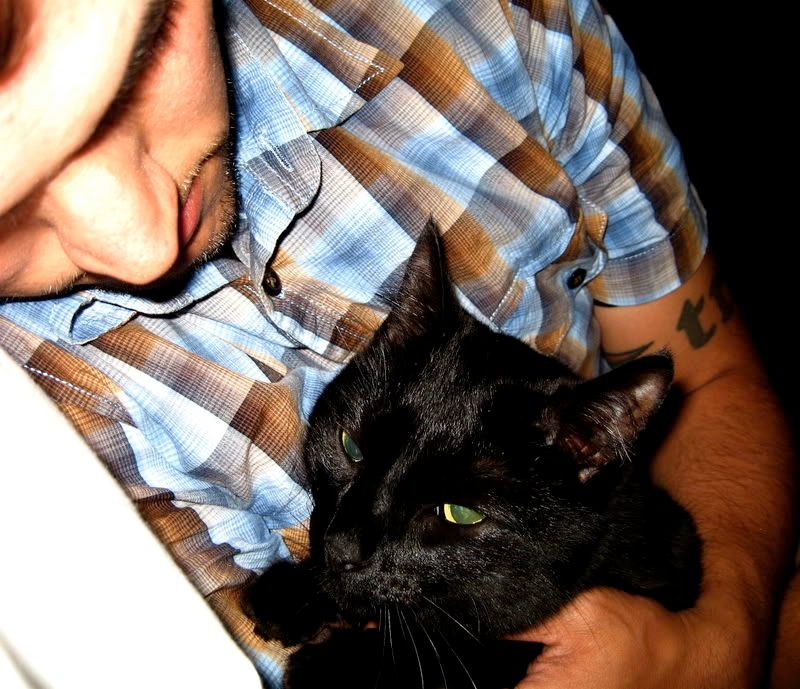
Beyond that, NYC was a blur of bedhead, coffee, vegan restaurants, bookstores, demanding cats, and sore feet. We didn't catch up with nearly as many folks as I'd have liked, but that really just makes for convenient cause to go back again and often.
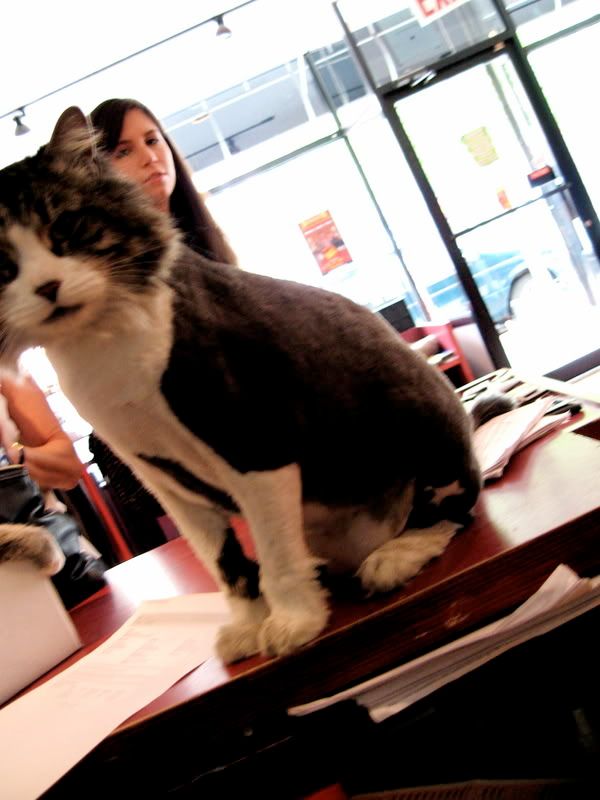
[This little one fussed at me, and kept tabs on the goods at MooShoes]


[This little one was adamant that no one in her house should ever sleep... Or do anything but play with her]


[The bus ride home was Lindsey's favorite part]

Tuesday, May 15, 2007

Travel: Big and Small, pt. 3


When I made a veritable day job of walking dogs, I did so having realized that in most meaningful ways, it was preferable to every other work environment I'd taken up, prior. Within eight months, I'd left town to study for two months in Vermont. Just three months after returning, I'd found a subletter for my room at Casa del Ajo and skipped town to play shows across South America, the US and Europe. Thereafter, my work was punctuated (albeit, less and less) by this or that tour, more study jaunts in Vermont, a trip to Palestine, weekend conferences, etc. In short, my job was more or less a mechanism by which I sustained routine (if not entirely constant) motion. Generally, that was in place of any authentic stability, but the jury was still out on such things being altogether desirable at that point, anyway. So, in the end, work rarely felt like work. It was merely what I did from 12-3pm, when I wasn't doing whatever it was that made that particular day interesting.

Upon launching Brighter Days, I found myself wet-headed in the kitchen, filling the coffee grinder earlier and earlier. And the previously optional administrative elements of my work (not to mention my resistance to them) began swallowing up more and more of my day. Mind you, this is down to a relatively conscious decision to fuse my livelihood with the fairly radical reconstructive vision of society that animates most other aspects of my life; a decision I have zero cause to mourn. Nonetheless, what was once a line of work I relished for its simplicity and comparatively undemanding character is increasingly something on which I could spend (quite seriously) every waking minute.

Granted, there's delegation; we're a collective after all. I'm shitty with numbers, and have a proven record off piss poor attention to financial matters. So, I play as little role in such things as I reasonably can. Nonetheless, there's a seemingly bottomless creative potential in what we've set out to do, which leaves me with any number of other tasks. Where a business website might traditionally hem rather closely to the promotional/service template, ours can also serve an informative and radicalizing function beyond what is strictly lucrative or instrumental to our individual material interests. It constitutes both a step past capitalist logic (i.e. the radical possibilities of merely supplanting Use Value for Exchange Value) and an attempt to forge new connections; to render tangible what we see to be the nakedly apparent bridges between the world of a handful of bike-happy anarchists (and the constellation of radical social projects in which it resides) and the worlds of people who stumble on to our website. It's an opportunity to challenge assumptions, pose questions, and foment a sort of cognitive dissonance that lingers long after the banalities of the company-client relation have been resigned to background noise, or abandoned altogether.

Search all you like. There's no such volume in the "... for Dummies" section of Barnes & Noble (or Busboys, for that matter). The same goes for merely experimenting with infrastructure and organization in a self-managed workplace. The actual labor that constitutes the face of what we do is now little more than a footnote, really. And what resides beneath it is by all indications relatively infinite.

Needless to say, Lindsey's arrival on the scene threw a whole other set of variables into the fray. It's not even an equation I've entirely worked out, at this point. Being emotionally available and present, while dragging around this whole other bag of (rather compelling an exciting) unknowns is not the sort of thing for which there exists some sort of kill switch. Life just doesn't work that way, and there's something altogether more demanding than that in the challenge. If there weren't, it'd be a pretty cheap and uninteresting narrative, I gather.

Which brings me back (nearly full circle) to the theme I explored in the first entry of this blog: Becoming; the recognition that one cannot be what one was, that one must forge new resonances, new positions, new ways of orienting oneself to the world with which one is greeted each morning. It's relevant because a few days ago I woke up to a world in which I was someone who needed a vacation. I'm not even kidding. The endlessly multiplying lines of flight (all more or less equally compelling) arising in the creative -- and by that, I mean predominant -- sphere of my life had proliferated to the point of being a single, dulling frequency, utterly indistinguishable from one other. And my orientation to it all had become a sort of averse and passive lockgroove of convincing myself that "It can wait", which in turn became its own static feedback loop.

Besides, I needed a new belt. Which obviously meant going to NYC. More on that later.

Tuesday, May 08, 2007

Monday, May 07, 2007

Travel: Big and Small, Pt. 2


Small business ownership (or self-employment, take your pick) offers, if nothing else, convenient means of rendering one's passions a tax write-off. That is, of course, if one's line of work has anything whatever to do with one's passions. Being a worker-owned, ecologically-sustainable "workplace" (as it were) means that our collective romance with liberation and... Well... Bikes, becomes an excuse to withhold money from Uncle Sam. Back in March, we donated over $500 worth of services to the annual fundraising auction held for the Washington Area Bicyclist Association, and this past month, we kicked $200 to Visions in Feminism (and indirectly, Helping Individual Prostitutes Survive).

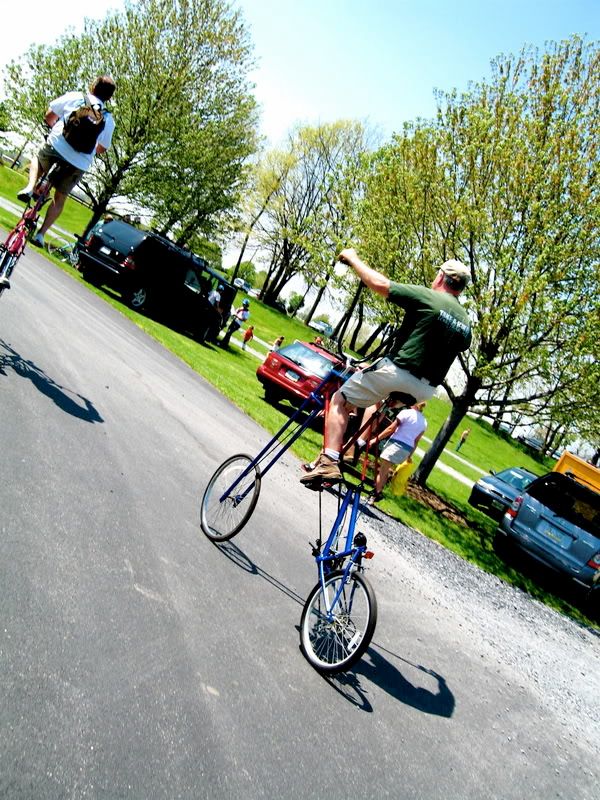
And this past weekend, we took our first collective road trip to Trexlertown Velo Swap, in eastern Pennsylvania, an an effort to acquire gear on the cheap. Sadly, this was derailed due to poor highway signage in the region (despite our getting up at 6am to make the morning scramble). By the time we found our way there, it was pretty well picked over, but I did manage to score a set of 170mm Dura-Ace track cranks and bottom bracket for about half of what they'd have set me back, otherwise. Devin and Seager settled for soft pretzels from the concession stand.


After a brief stop at Seager's family home in Bucks County, we shot east to Philly, where he and Devin browsed record stores, and where I stuffed my face at Gianna's Grille. Worth noting is the vast improvement in their vegan dessert case. Holy fucking fuck. Boston Creme-style canoli with chocolate shavings and peanut-butter drizzle... Easily one of the best vegan items that's ever found its way into my mouth.

[Vegan junk food... Canoli not pictured]


[Seager, seconds after Devin informed us he'd "miscarried" in a cafe bathroom]


I'd really forgotten what a charming place Philly is. For starters, it seems to have retained a stable working class at its center (whereas that section of the District's population is largely on its eastern periphery), which makes for a really classical urban feel one imagines older US cities to have. Seven years ago, I was in and out of the city every so many months; whether it was helping gut the newly acquired IWW HQ, a stopover on the way to NYC after hearing the Diallo murder verdict, the RNC protests, or the nearly weekly legal strategy meetings or court appearances I had to make, thereafter. And I'd sadly forgotten what a genuinely gorgeous city it is. Perhaps most noteworthy from this recent visit were a series of vaguely cubist murals that have been added to the sides of a number of houses/buildings around South Street. Stunning stuff that I stupidly neglected to photograph.

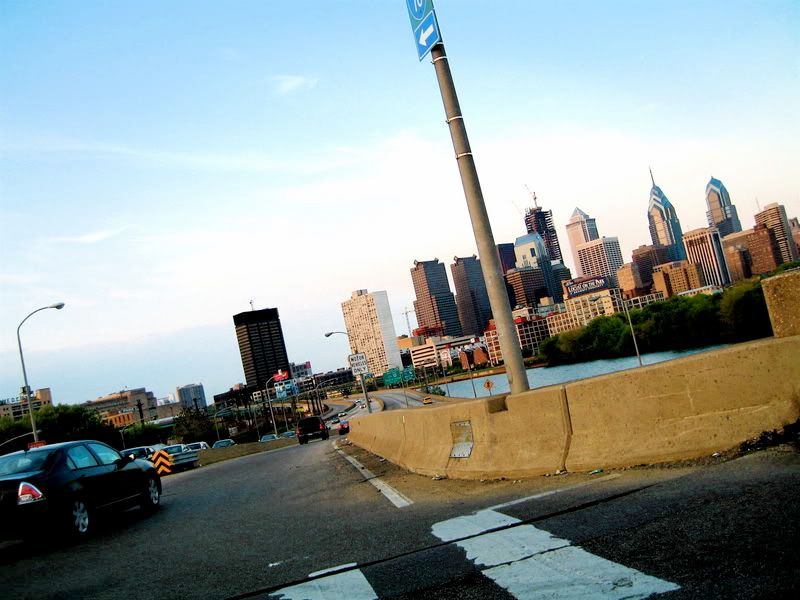
[City of Brotherly Love, outbound]


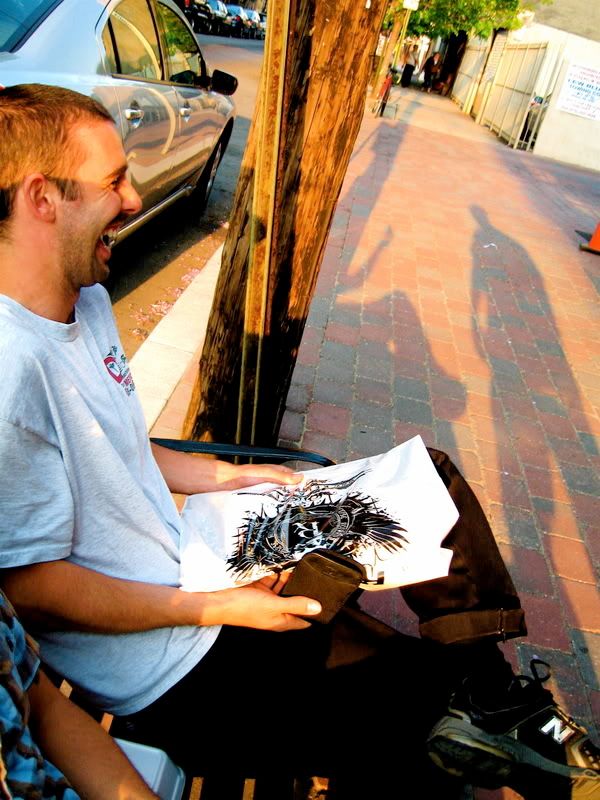
[Benched]


Next stop, NYC.

Thursday, May 03, 2007

Either it Matters or it Doesn't.


Yesterday, I made my morning pilgrimage to Sticky Fingers, and bumped into a character (who will go unnamed for now) I used to do organizing with. He was rather polite and friendly with me; odd given that he'd been central to a number of efforts to insulate to local A-circling anticapitalist youth ghetto from accountability for its often overt racism and nakedly racist and colonialist subtleties -- usually by slandering, attacking, and silencing yours truly (or others) when challenges to said practices were mounted.

Yesterday, he was sporting a tshirt in support of Daniel McGowan, an environmental activist from the Pacific Northwest who recently plead out on federal charges resulting from an "ecoterrorism" sting. Granted, the FBI raids on these people and the movements they're a part of are dubious, overzealous, and nearly indefensible given that they're explicitly non-violent, and given the very real violence of the industries they're often targeting (carbon wasn't declared a federally regulated substance for nothing, kids).

But given the low level of confrontation in our morning encounter, I wanted to ask, "So, I'm curious... How many shirts do you own supporting Arab political prisoners? Or Latino detainees? For that matter, can you name an Arab or Latino political prisoner?" But I bit my tongue, opting instead to evade playing into what I'm sure is the caricature such people have constructed of me.

Nonetheless, it begs certain obvious questions. One can nearly hear George Galloway's now infamous Scottish-accented "What a silly person you are!", and his outrage at a SkyNews anchor who publicly mourned Israeli casualties of the invasion of Lebanon last summer, while not being able to name a single member of the Palestinian family that had (just weeks prior) been shelled by Israeli tanks, during a beach picnic in Gaza. The equation is the same: Certain bodies weigh more heavily on our collective conscience than others. You can scour the Brian Mackenzie Infoshop, and you won't find a "Free Dr. Sami Al-Arian" shirt, anywhere. You'd be hard-pressed to find anyone there who knows who he is.

Days ago, police uncovered what is being described as the largest weapons cache in "years" in the southeastern US, in the hands of a rightwing militia that Democracy Now! reports was planning attacks on Latino immigrants. The charges brought against these (white) men? Conspiracy to make a firearm, and being a drug user in possession of a firearm (entailing a maximum five-year sentence). Lucky for them, there is no Guantanamo for white people. Were they not white, they'd be hooded, diapered, and air-bound for some Black Ops facility in Eastern Europe or Southeast Asia right about now (likely to be tortured and held incommunicado for years), and we wouldn't be reading about it on Yahoo! News.

In this discourse that is so inviolate and sacred for anticapitalist youth-culture, one is sort of left wondering where our similarities stack up... With the Sami Al-Arian's of the world? Or the white-supremacist insurrectionists counting their lucky European genes that they're not buried in some Egyptian dungeon, water-boarded? Either it matters or it doesn't.

______________________________________

BIRMINGHAM, Ala. - Raids that resulted in the arrests of six alleged militia members and the seizure of hundreds of hand grenades and bullets were "much ado about nothing," a defense lawyer said Friday.

A cache of ammunition that was confiscated — 2,500 rounds — wasn't that large, and the scores of homemade hand grenades that agents seized could be made with powder from fireworks and components readily available in military surplus stores, attorney Scott Boudreaux said.

Even prosecutors say the ragtag group called the Alabama Free Militia had no intended target and was simply stockpiling munitions, said Boudreaux, who plans to meet this weekend with his client, Raymond Kirk Dillard, 46, of Collinsville, a supposed major in the paramilitary group.

"Frankly, I don't think that's a big deal," said Boudreaux. "It seems to be much ado about nothing."

Jim Cavanaugh, regional director of the Bureau of Alcohol, Tobacco, Firearms and Explosives, said the raids eliminated a huge threat. The Anti-Defamation League, which tracks extremist organizations, said the weapons seizure was the largest in the South in years.

"The arrests and the seizure of such an enormous arsenal are a compelling reminder that extremist groups continue to operate in otherwise peaceful communities filled with law-abiding citizens," said Bill Nigut of Atlanta, ADL regional director.

Five men were jailed without bond on federal charges of conspiring to make a firearm after the raids, conducted early Thursday in four Alabama counties. They included Dillard; Adam Lynn Cunningham, 41; Bonnell Hughes, 57; Randall Garrett Cole, 22; and James Ray McElroy, 20.

A sixth alleged member, 30-year-old Michael Wayne Bobo, was charged with being a drug user in possession of a firearm.

Don Colee, an attorney for Hughes, said all six men were due in court on Tuesday for a hearing where a federal judge will determine whether the government can keep them in custody.

Dillard lived in a small camper without electricity or running water in northeast Alabama, and neighbors said McElroy lived in a makeshift tent nearby. Bobo lived with his parents in an upscale subdivision in suburban Birmingham.

A court document indicates Dillard, unknowingly met with an ATF informant at a flea market in Collinsville about four months ago, told him he was organizing a militia and later accepted him into the group as a sergeant major.

The informant was at the home of Cole, an alleged militia lieutenant, about two months ago when he saw grenades, according to the document, a sworn statement by ATF agent Adam Nesmith. Investigators found more weapons as they monitored the group through the informant and with video and audio surveillance, Nesmith said.

During the raid, agents recovered 130 hand grenades, a grenade launcher, about 70 hand grenades rigged to be fired from a rifle, a machine gun, a short-barrel shotgun, 2,500 rounds of ammunition, explosives components, stolen fireworks and other items.

U.S. Attorney Alice Martin said the fireworks used to make the grenades were commercial grade, not the type sold in retail stores in Alabama.

"Even to possess these fireworks without a license is a felony in Alabama," she said.

[Actual story here]

Tuesday, May 01, 2007

Travel: Big and Small, Pt. 1.


[Note: For the coming weeks, I'll be posting (largely) in transit. And until further notice, it will likely be the recurring theme, here.]

Looking back, the odds of it happening the way it did seem implausibly slim. We'd met a few times by way of Seager, she even tagged along with his other housemate when T. and I invited them bowling late last year. When Willie played with Joe Lally after New Years, she turned up, and accompanied us to Ella's, despite having other plans. We cooked food together before the Super Bowl, watched a movie or two... But it was always circumscribed by my relationship with Mr. Seager, and her proximity, as his housemate.

But I noticed.

And I kept noticing.

The odds she'd be shuffling back down the stairs, to the couch adjacent to the one I'd staked out for the night were equally slim. The odds we'd spend just five nights apart in the three months that've followed since she offered me the empty half of her bed were... Well, unthinkable, really. And yet, curious as such a narrative indeed is, it has unfurled just that way.

I never saw it coming; likely why I've given it next to zero mention here. Merely giving it any concise treatment required a context I didn't have the energy to provide. The people who needed to know were brought up to speed, and there's a nagging disinclination in me to publicize something so nuanced, and simultaneously so not my own. I've been keen to preserve its dignity and integrity. But it has happened, and I've begun to feel awkward not mentioning it. Quite unexpectedly, I have been swept off my feet.

And it bares mentioning here (now) insofar as it means that my days on The Hill are numbered. In the double digits. A change that marks a rather radical departure from the conditions under which I began this blog, even. Nonetheless, pretending that we do not live together has become such an exhausting drain on our time, energy, and finances that (after considerable discussion), we've opted to simply stop pretending. Thus, my library, will soon share space with her library.

Tuesday, April 17, 2007

Protect me from what I want.


If you're expecting much commentary on our great nation's most recent homage to the Second Amendment, look elsewhere. Frankly, I think we can all empathize with the families and loved ones of the victims, using our indoor voices, and beyond that there isn't a hell of a lot to say on the matter that hasn't already been beaten into the ground. There was a massive march here in the District yesterday to demand that the federal government extend the same pretenses of democracy for which we're occupying Iraq to our fair city... A demand recently underscored by efforts on the part of states like (wait for it...) Virginia to repeal our assault weapons ban against our will. Betcha didn't hear about any of it, due entirely to Virginia not being able to hold down its own fort. Well done, guys.

Moreover, a recent guest on Democracy Now! pointed out an interesting statistical nuance to american culture: Since such records were first kept (around the late 1940's), indexes of americans' happiness and fulfillment with their lives peaked in 1956; or at least so americans surveyed have said. Since then, the stats have steadily declined. Conspicuously, this has accompanied massive and sustained economic growth, throughout. There are two obvious (one more so than the other) ways to read said correlation. One: This steady and sharp economic growth has (at best) not left people with the impression that their lives are significantly better, or (at worst) has involved shifts that have significantly encroached upon or diminished happiness and fulfillment as americans experience it. Two: The steady economic growth in question owes something to economic opportunities offered by widespread dissatisfaction and alienation.

So, while one set of profiteers underwrites the entire mainstream political spectrum, to ensure the durability of the gospel of quantitative economic growth at the expense of qualitative improvements in the lived experience of those pinned beneath it, another set does everything in its power to see that we're armed to the teeth; usually against each other.

For those who haven't yet seen the film The Weatherman, I highly recommend it. It's a beautifully understated work that kinda came and went before anyone really noticed. Roger Ebert's review kinda hit the nail on the head, remarking that most depictions that fall within the tragic hero genre involve some titanic figure set against some expansive and foreboding backdrop, at an equally dizzying height; their fall from which constitutes the trajectory of the film. In the case of The Weatherman, the protagonist didn't have very far to fall, to begin with, which makes for a narrative into which one can quite easily read oneself; a narrative that in this particular case I would argue says something rather profound about how we see ourselves, and the vignettes we labor to replicate in our lived experience, often at the expense of what's front and center.

All of the people I could be... they got fewer and fewer until finally they got reduced to only one -- and that's who I am. The weather man.


Bigger Picture Darwinism.

A year or so ago, on a cool Thursday mid-afternoon, I soaked with a friend in a rear-deck hot tub just north of 4th and D SE, on Capitol Hill. It was a work day, and a client's house; a client that had invited me to make use of the extravagance, given her home's impending sale. Earlier in the week, I'd been forced to retire a cell phone after plunging it into the tub, attempting to multitask text messaging and swatting at a mosquito. By all accounts, it'd been a good week.

"So, let me get this straight," my co-tubber quipped. "You dropped out of high school, dropped out of college, earn more walking dogs four hours a day than either had to offer in the way of job prospects, and you're currently playing rockstar in someone else's backyard hot tub while the rest of Capitol Hill is just getting back from lunch. How does this work, again?"

Short of an explanation that involved the Good Lord lookin' out for me, or some speculative metaphysics vis a vis the rewards of "staying true" to oneself, I really didn't have an answer. Last I checked, the classifieds weren't exactly brimming with openings for Amateur Intellectual or Serial Flatulator, so I opted for the most honest answer I could offer (after insisting that Crimethinc had nothing on me): "I don't know. Necessity is the mother of invention, I guess."

And that's probably true in two relatively distinct, but intertwined, dimensions. I wasn't always doing what I now do. I've done everything from jockeying the graveyard shift in a 24hr copy shop, to selling roses to commuters on one of the more remote connectors between northwest DC and the Beltway, to gigs at bookstores, to pulling admin duties at an animal rights organization, to staffing a haven for homeless women . Oh, and I went to college for a bit.

Nonetheless, my fidelity to institutionalized learning was always short-lived. And my patience with the arrogance of employers who kept me at their whim for measly returns was threadbare by 21. No career that might entail any promise wanted the smartass who told the university to take a flying fuck. And my willingness to allow the small miracles of daily life play second-string to helping Larry King find the new OJ tell-all bought the farm about the time I saw my last retail paycheck. All of the people I could be... they got fewer and fewer until finally they got reduced to only one -- and that's who I am. The dogwalker.

So theory's dead, eh?

I'm hesitant to speculate as to the upbringing of others, but in this particular narrative, it's fair to say that mine was characterized by a dialectic of faith and disillusionment. Not in the dramatic sense of routine heartbreak or emotional duress (per se); more in the sense that virtually every time I took adults seriously, as to their descriptions of the world I was coming into, I ultimately discovered that taking the path(s) depicted therein as necessary was invariably little more than a gamble. And in most of those instances, I frankly hadn't signed up for a gamble; I'd sacrificed my time, desires, and (often enough) dignity for what I'd been instructed was a necessary chapter of some progressive narrative inhering tangible reward.

Well, shit. Life was a matter of gambling about the time I started breathing, I reckon. And if we're to (for instance) dispense with the notion that throwing ourselves through a set of hoops inextricably bound up with market imperatives (ask any of the umpteen-thousand med students defaulting on their loans on a given day) is somehow a fact of life, then we perhaps have the space to approach our decisions in terms of what they meaningfully offer us here and now, tangibly (see Foucault's Aesthetics of the Self). We have the space to determine what gambles we will and will not shoulder. We have the space to see our lives, not as something to sacrifice, but something to curate, something to adorn, something to fill out, and perhaps something that fits quite nicely between the gears of any of a number of repugnant systems.

And while I mean to denote something altogether different, it's perhaps ironic that I invoke the impasse any of us might pose to a given "system"; Lyotard's rejection of Systems Theory (in the closing passages of The Postmodern Condition) offers a fairly concurrent logic:

The system can only function by reducing complexity, and... it must induce the adaptation of individual aspirations to its own ends. The reduction in complexity is required to maintain the system's power capability. If all messages could circulate freely among individuals, the quantity of the information that would have to be taken into account before making the correct choice would delay decisions considerably, thereby lowering performativity. Speed, in effect, is a power component of the system.

The objection will be made that these molecular opinions must indeed be taken into account if the risk of serious disturbances is to be avoided. Luhmann replies, ...that it is possible to guide individual aspirations through a process of "quasi-apprenticeship," "free of all disturbance," in order to make them compatible with the system's decisions. The decisions do not have to respect individuals' aspirations: the aspirations have to aspire to the decisions, or at least to their effects. Administrative procedures should make individuals "want" what the system needs in order to perform well.
[Emphasis added]

Perhaps that requires a bit of unpacking (and Dr. Seuss works just as well). Regardless, the operative tension is between our desires and a given system's performativity; its ability to meet some pre-determined objective efficiently; objectives to which our aspirations are daily "quasi-apprenticed."

The last few months, Brighter Days has been (no pun, here) like a dog, sprinting ahead of us with the leash whipping about, behind. We're all doing quite well materially, have been throwing resources to local projects in need of support, and are individually plotting a number of months away from work, pursuing everything from band tours, to language immersion in Europe and Mexico, to possible presentations at the US Social Forum in Atlanta and a conference on Self-Management in Buenos Aires. Slammed as I tend to be with my work, I wind through my day atop a 49x17 gear ratio, in a hoodie, jeans and beat-up slip-ons, kept company by whatever news I dumped onto the iPod during my (nearly) daily breakfast date with Seager at Sticky Fingers.

Life could be a lot worse. And not by accident. This week, the rest of the collective has agreed to free up my Fridays to allow me time to work for the IAS; a prospect I'm allowed largely because I didn't make other decisions. Namely, I chose not to want what the system in which I'm daily immersed needs in order to function efficiently; I chose to accept that when I shuffle off this stage, nothing I've accumulated will come with me and nothing that system could ever sell back to me will replace what it's taken away. That realization could've produced altogether other results, as I would hope Virginia Tech... and Columbine... and every other unspeakable act of despair might remind us.

"Even if this system were to go to the point of bluntly proclaiming that it imposes such an empty and hopeless existence that the best solution for everyone would be to go hang themselves, it would still succeed in managing a healthy and profitable business by producing standardized ropes. But regardless of all its capitalist wealth, the concept of survival means suicide on the installment plan, a renunciation of life every day." - G. Debord

Thursday, April 12, 2007

I stand corrected, it would seem.

Once a member, I've grown quietly dismissive of recent IWW campaigns (particularly on the east coast... The west coast has accomplished some substantive shit, for sure). Most of the folks I know in the union resemble very little in the way of a departure from your average Civil War re-enactor; lovelorn for an era and a tactical format that breathes in the Postwar US the way a trout breathes on a river bank.

Nonetheless, this is an encouraging blow to the PR machine of an entity whose odiousness is only surpassed by its own ubiquity. My hat's off to you, brothers and sisters. DC folks may notice that a member of a certain, sorely-missed dance-punk trio had a hand in the Post's coverage of the campaign.

And while we're at it, abrazos to the Immokalee Workers in their second big win of recent years.

Tuesday, April 03, 2007

Notes on Misplacing Tragedy

[Note: Regular readers may find this particular post a bit esoteric and/or opaque. Apologies. My intent was to give words to a number of things for which I'd had little occasion or audience over the last ten or so years, and the audience in question is rather specific. If you find you're not part of it, do feel free to skip it. In the end, dispensing with shorthand and common references would've rendered this a rather boring read. Do feel free to skip it.]


Yes. So many memories. But sad? Really?

No, friends. Sad is that this selfsame NATO installation was used to carry out one of many massacres, while our vice principal was busying himself disabusing me of the notion that any institution exists to do more than perpetuate its own status quo. Sad is that prior to said massacres, and the impending UN sanctions that killed over a million people (half of them children), Iraq had one of the most secular and highly educated populations in the Arab world; certainly one of the most favorable toward women. Those fundamentalists driving payloads of explosives into produce markets? Yeah, they didn't just fall out of the sky. We created them, when we carelessly murdered their mothers, aunts, sisters, cousins, wives; when we encouraged them to rise up, realized any democracy they'd establish wouldn't take orders from us, and then stood down while Saddam wiped them out; when we destroyed their health and sanitation infrastructure and banned the import of anything that might rebuild it; when we left their children to die of gang green resulting from paper cuts.

Sad? Sad was sitting at in a church at 15th and V, nine years ago, at Greg Proctor's funeral... And realizing that probably none of the Sig faculty ever apologized for making him their patsy in the infamous "Tennis Court Incident." Sad was being regaled on my morning bus jaunt from Nicolosi by a thirteen year old girl whose father routinely ordered her brother to "slap her till she bleeds" when the hot water happened to run out during her shower. Sad is that said brother took Greg's place overseeing the student council.

Sad is that no one blinked when certain athletes in our midst were quietly bee-lined Stateside when the cops came looking for the drunk americans that had put a Sicilian man in the ER during a night of rock-throwing in Motta; or when "Bum Day" was half the student body showing up with signs reading Will Work for Food. Sad was hearing all the third-party accounts of who sexually manipulated and/or abused who on whatever bus trip was masquerading as piety, charity or school spirit that particular week, and the fact that this was humored and filed under "not a problem" by every responsible party, top to bottom (never mind that said tropes remained more or less water tight).

And perhaps it's just the default american high school experience (Columbine, anyone?), but ... so many memories," as though it's somehow nostalgic? My memories involve watching my peers abuse alcohol like it was going out of style, watching them fail to experience any sort of epiphany or cognitive dissonance at the moment they found their lips around the nozzle of a gas can, retrieving them from the ER after a drunken game of "corners" (don't ask) in Motta, watching them abuse each other in some of the most vicious displays, hearing about the Ex-O's daughter poisoning a teacher's drink, seeing teachers bend the rules to cover for and enable the most thuggish and anti-intellectual of our ranks (diplomas were issued to athletes whose tirades against evolution betrayed a staggering ignorance of even the most rudimentary biology, for instance), and the recurring nightmares my first year Stateside, where I'm riding shotgun with my mother, sobbing, begging her to let me leave.

Let's not shit ourselves, last I gave it a gander (likely some eleven years ago), The Stars & Stripes was reporting that Sig's academic sphere suffered one of the worst behavior and lifestyle crises of the region. Kids setting locker rooms on fire, throwing each other through walls (in computer labs, no less), kleptomania, and youth center on the verge of structural collapse... And let's all not forget that (now legendary) incident in which a former wrestling team captain's ass-flesh was left dangling from the remains of a shattered glass pane. Anyone paying attention knew something was very, very wrong. And I'd go so far as to say that any of my peers who doesn't recall half their waking hours being swallowed up with their peers (quite rightly) verbalizing their outright misery is just plain lying. We lived for our departure the way many around the District live for Bush's last day in office, and the effort young women around me put into snagging whatever guy made for a flattering photo and envy-worthy story to send to friends Stateside (no matter how degrading, abusive, or just plain unremarkable he was in real life) was nothing short of dizzying. Most of us lived and breathed for a scenario well beyond our reach, and therein sought refuge from our actual conditions.

Perhaps most instructively, I remember the six months I got to skip my first class Mondays, to see a therapist after confessing to my mother that I'd begun to believe there might be a God, and that he had carried out every facet of his plan with painstaking precision and success... Except for one: He'd put me in a world in which all indicators suggested I was to aspire to the examples of the thuggish intellectual/ethical/spiritual bankruptcy and self-interest of my peers, or the mediocrity, resignation, and (in the worst cases) downright cowardice of the adults around me... All of this being the world He had planned; a world with which I felt fundamentally incompatible, with every inch of me that breathed... A world with which I had accepted I would never be reconciled.

She suspected I might've been suicidal, and she might not have been wrong. Sig provided me with such an unappealing (read: repugnant) sense of what adulthood and the world in general had to offer me, I'd come to accept that I probably wouldn't live beyond my early twenties. I don't say that for dramatic effect, I genuinely believed that. I'd not grown so cynical as to call it a day just then, but I was not confident that whatever cursory run I gave adulthood would be so compelling as to to prevent me from taking my leave of it shortly thereafter. And (as any who've known me for any recent period of my life can likely attest) the years since have seen me flatly refuse to hand over any quantity of my dignity, time, or energy in a gamble on my "future;" I'd given five years to one transparent lie after another, under conditions in which I had no choice. Even if longterm stability were at stake, I would never again cede my present to the idea that it would somehow pay off later. And the last twelve years have seen these legs carry me as far from what Sig offered as was physically, spiritually, and ethically possible.

The day I turned my books in and walked out, halfway through my junior year... It wasn't out of an apathy toward the life of the mind. It was the first day I'd seen my biology teacher in months, sure. But had anyone wanted to, I wouldn't have been hard to find. I was holed up in the library, reading. The school library, no less. And (quite shamefully, though perhaps desperately) much of what I was reading found its way out of the library with me. I walked out that day after being diagnosed with severe stress headaches. The closer we hurdled toward being released from that space, it seemed, the more adults around us became our cheerleaders. And for what? What exactly had we learned or become? It scared the shit out of me that anyone was satisfied with it, much less championing it. And it foreshadowed the precarious and (indeed) catastrophic mediocrity that awaited me. I left because my body could no longer take that.

When the Abu Ghraib scandal broke, I was sitting on a couch in the home of a staffer at the US Embassy in Vienna, with a friend who'd grown up in East Germany and spent five weeks of his nineteenth year incommunicado, after being imprisoned for attempting the climb the Berlin Wall. Those in my company were appalled by the story coming out of Iraq. Fully nothing about it shocked me. Nothing. It was a logical and intuitive elaboration of the very racist arrogance that served as the foundation of life in Sig; a world in which we unquestioningly celebrated, rationalized, and believed any and all in which we saw oursevles, no matter how vacuous, violent, malicious, or transparently false. A world in which we ignored, dismissed, or suppressed all in which we did not. A world in which such patterns were afforded official sanction (indeed, encouragement). And not a day passes in which I'm not absolutely terrified by the casual and indifferent gaze cast upon such worlds, much less the manner in which hindsight might leave one with a nostalgia for them.

Worse still, after all those years suffering that shit hole right next to all of you, hearing and sharing your pain (perhaps in different ways), watching you cope (often in equally disturbing ways)... I've -- in all seriousness -- mourned the fact that so many of you have opted to duck right back into that community. Not for your own sake, mind you. The world is not a cake walk, and I don't discount that material stability and lack of contingency provided by life in the military community. But I mourn that you would be so willing to possibly subject your children to what we endured. I mourn that you've forgotten what that looked and felt like.

Ultimately, whatever paths we've chosen upon getting out from under that experience (certainly, many of you have not found your way back to the military)... Seeing all the emails back and forth waxing nostalgic about Sig, and our time there, and what a shame it was to see the structure that rendered much of our experience invisible demolished...

I guess I just worry that it's a reflection of what we've failed to do with our lives, since. If something so miserable, something that often drove us to the brink of irreparable self-destruction, something that stole so much of the challenge and promise and unknown of what those years should've held for us... If that's worthy of romance, if its physical representation is worthy of mourning in contrast to what's found its way into our lives since... It perhaps marks a point of reflection.

And in that reflection, I sincerely hope that every last one of you is happier than you've ever been.

Sunday, March 25, 2007

The Inevitable Thaw


And I don't know why,
But I've been wasting so much time. And energy.
Relishing your opinions of me.
I'd much rather spread my own wings, than spill more of my blood...
The instilled fears, inhibitions, and tears
Have all disappeared, since I dared to ask myself:
What about my life? What of this life?

[Endeavor]


I re-read that little Foucault quote, here. Right after reading a message from an old friend who attended an event I set up a few nights ago; remarking that she was heartened to see that I'd once again softened to the idea of occupying some space of relative visibility in my work. I've tended (for some years now) to take up roles somewhat left-of-frame, insulating myself from the invariably petty and equally vicious assaults one seems to invite in this town, as soon as one puts one's name on anything.

Truth is: I haven't softened to jack shit. But maybe I need to. When I'd originally adopted the aforementioned strategy, I commented to a friend "The genuine assholes of the world number relatively few. It's the sea of cowards in which they swim that ultimately casts the deciding vote." And I haven't really lost sight of that contingency, nor do I believe that that sea is populated with any increase in promise, at present. Rather, recent events would seem to indicate things have hardly ever been more the same.

But I'm no longer and island, either. More on that, later.

Sunday, January 07, 2007

The Party's Over.

[New Year's Eve at the Brighter Days compound]


Don't worry, kids. You didn't miss much. The last 1/3 of the Ought Six saw me doing little more than what you probably already suspected: Abusing coffee, tinkering with bikes, accumulating books, smooching a certain redhead (who has since bid the District farewell), and losing myself somewhere between my trademark procrastination and my newfound status as Business-Owner. A bit of spiritual housecleaning has allowed me to love a few people a bit more, and opened the door to possibly throwing a bit of that in my own direction one day. But beyond all that, my neglect of this vehicle has likely left very little unsaid. These things ebb and flow.

I've been working on a few bits of writing, with a bit more density, which will eventually turn up here. But I'm taking my time, and -- quite frankly -- my confidence with regard to all things traditionally creative was on its way out the window most of '05. So, it may not be a particularly speedy process.

A few random observations from '07 (thus far):

*The opening track of the new Damien Rice record is positively chilling. If you're going to steal the melody to What if God Was One of Us?, this is exactly what you should do with it (the fourth song ain't bad, either).

*Marina Sitrin's work on Horizontalism is finally available in English, and it just as easily could've been subtitled Badass as We Wanna Be.

*I've been living on the west end of the Hill the last week, dogsitting in an apartment just behind the Hart Senate Building. This means walking a dog in the general vicinity 3-4 times a day, frequenting the coffeehouses in the area, etc. Anyone who knows the neighborhood can picture the demographics; we're talking Securities and Exchange Commission, Federal Judiciary, Republican National Committee, Heritage Foundation... And all the types that work in or in conjunction with said establishments. Judging by my (mind you, brief) interactions with women during my meanderings there, you'd think it'd been months since they encountered a gent who wasn't a complete and utter douchebag. Cue Trial's anthem, "Are These Our Lives?"

*Sticky Fingers, since their big move to Columbia Heights, has managed to produce the finest soy chai on the planet. No diggity.

*Seager's into ponies.

Tuesday, November 14, 2006

Three Years Ago Today...

As some of you may have noticed, I've been pretty slow to post here as of late. Not for lack of trying, I assure you. I've got two longer, more dense pieces I've been working on, and am in the process of applying to the Path of Engagement program out in California. I'm also absolutely slammed with paid and non-paid work right now, which doesn't offer much in the way of the sort of free time one needs to write in any meaningful way.

However, recent events in Gaza, namely the Israeli shelling of of a home killing some 18 sleeping civilians, and the US veto of the UN Security Council resolution denouncing it, saw me going back to the journal I kept during my time in the Occupied Territories. Reading it over, I almost feel like I've somehow grown intellectually and spiritually dulled since. It highlighted questions I seem to have forgotten, and cast a different light on things I've grappled with more recently (especially in my spiritual life).

So, I've created a separate blog, where (for the next few weeks) I'll be posting the entries from that journal. Hopefully, they'll offer some of you something; not necessarily in terms of insight about the Occupation (much has changed in three years), or the politics of solidarity or whathaveyou... But perhaps in the way of what it means to be present in this life, what it means to be still enough to observe exactly what we don't know; what's at stake in our relationship to suffering, perhaps.

Joshua in Palestine (2003)

Thursday, November 09, 2006

Taking Refuge, Pt. 2

I had such a tremendously shitty afternoon; I've been so slammed with work-related tasks for the last month, and between unforeseen technical glitches, and my own inability to acknowledge when I've over-committed myself... I'm fucking up, left and right. And it's embarrassing, and it hurts, and while it prevents me from really being present, it also metastasizes into a sort of paralysis (which just makes everything worse). And in turn I have to fight even harder to catch up. It feels like it never stops.

And tonight, I had the opportunity to listen to a friend talk about how she's considering checking herself into a hospital for clinical depression; how she catches herself sabotaging her relationship with her partner, how she can't understand it, and can't forgive herself for it. Ultimately, how helpless she feels, and how sick she is of having it dismissed by friends as mere "stress." I feel like I'm the worst person ever, she said.

Nearly six years ago, at the outset of what would turn out to be one of the worst periods of my life, I turned back to the Dharma practice in which I'd dabbled since I was about 15, but I wasn't prepared or ready for the real work of it. I sat in my livingroom, and began a Metta (lovingkindness) meditation, aware as I was of my steadily escalating anger and lack of forgiveness for certain people and events in my recent life (a fact that was beginning to swallow me alive, and would continue to for a few years). Most Metta practices involve quietly offering compassion to various people, usually beginning with oneself and as one becomes comfortable, moving outward to people further and further removed from oneself. It's a practice, it's not like hitting an inhaler to diffuse the onset of an asthma attack. But I didn't care. I just wanted to stop being angry, I wanted to stop being swallowed whole.

Within just a few minutes of working with that meditation, I was sobbing. I'd discovered that merely quietly offering myself the hope of being happy, being free from fear, being free from harm... I discovered that in some really deep, hardened place, I didn't believe I deserved it. And I was crushed by the feeling of being unmasked as that liar, that person that hated himself so thoroughly. I quickly abandoned the entire practice, and wound up opting instead for dialectic of sleep and eating disorders and an utter refusal to allow myself to uncover that self-hatred again. Six months later I was 35lbs thinner, hypo-glycemic, had doubled my cumulative count of sexual partners, and quit a job of four years to move to the other side of the country.

Then I read Audre Lorde's, The Cancer Journals, in which she wrote of her own struggle:

I must let this pain flow through me and pass on. If I resist or try to stop it, it will detonate inside me, splatter my pieces against every wall and person that I touch.

Tonight, I was able to listen, and offer a few suggestions for how to think about that pain, how to offer it compassion and know that it need not swallow us whole. How it merely needs us to acknowledge that it's happening, and not try to shove it out the door or hide it or compensate for it or externalize it (or our reaction to it). Or, in the case of my friend, to "fix" it.

In the Suttas that temptation to distraction and control is personified as Mara (illusion), and during his enlightenment the historical Buddha never made attempts to repress or or otherwise manhandle Mara. He simply said, "I see you." What was fascinating about tonight was not that what I understood (intellectually) about my practice was arguably helpful to someone else. In fact, I wasn't even terribly sure that was on the table. Rather, in attempting to offer that attentive, compassionate presence to her, I was able to realize how ridiculous my attitude toward myself has been all day. I emerged from the conversation audibly chuckling to myself: "I see you, Mara. Hang out as long as you like."

Goodnight.

Thursday, October 19, 2006

Sunday, October 15, 2006

You were wrong when you said everything's going to be alright.

I woke up this morning, decided today was the day. I'd remember to live a bit, to do a bit more than breathe; but not too far in. Those butterflies interject, and remind me that this is unfamiliar ground. - Endeavor

Yes, yes. I know. It's been a month (nearly). After Jeff's passing, I opted to take a few moments to shut the fuck up and reflect a bit; maybe let someone else do the talking for a while. A few moments became a few weeks, which bled into my inevitable return to Vermont, which bled into my final days there, which bled into my return home, which has seen nearly two weeks pass into a blur of rain and work demands stacked against a rather casual (but nonetheless heartening) romantic affair stacked against a not-so-casual but thus far vicarious attraction stacked against an impending birthday stacked against fuckhead insurance companies stacked against playing air drums to Cobolt's Great American Lies stacked against that spasm in the morning shower when your body decides to inform you that it's not ready to function (even after eleven hours of sleep).

I'm going to go ahead and blame coffee.

And truth be told, I'm not terribly convinced that there's much to relay, beyond what was substantive for me; hardly a yardstick for what anyone's interested in reading, here. But as I wrote to someone the day I left Vermont to come home, I have, in fact, come to a place where I can do a bit more than breathe. That is, I've located some flash of coherence in what it is that I do on a day to day basis. There's a life buried somewhere in there, and by that I mean something demonstrable; something that can be built upon and elaborated. Something beyond what I engage in to avoid making eye contact with my own dislocation.

It peeked out in the most unlikely places. On the corner of 16th and S, when she spun around, pulled me by my hips and kissed me as though I were hers, in front of every passing car; the moment my hands left her hips, and the realization that the world was still conspicuously intact. Or during the Anzaldua session at RAT, speculating that perhaps infusing our work with the erotic means embracing and honoring the same vulnerability that we bring to sexual encounters. Or hauling the sandwich-board from Black Sheep out to State & Elm mornings, savoring the anonymity, noticing the ways my feet would fall differently from the tensing and slacking of muscle in my arms. Or reaching that point with someone where I realize nothing I would want to say to them would be wrong.

Or maybe just coming home to the knowledge that I've been living with one hand tied behind my back... and being a little embarrassed about it. I woke up a year older today. And the world is still conspicuously intact. Go figure.

Saturday, September 16, 2006

Jeff Mendez, 1972 - 2006

Brother, I fear we would've never had enough time. I'd just begun to settle into the life that found us crossing paths with regularity, and barely got to glimpse into all I had to learn from you. Some other time, perhaps.

It is with profound sadness and grief that the US Campaign to End the Israeli Occupation learned yesterday of the passing of Jeff Mendez, a former Steering Committee member of the US Campaign. Jeff was instrumental in organizing the US Campaign’s 2nd and 3rd Annual National Organizers’ Conference in Washington, DC in 2003 and 2004. Jeff resigned his position on the Steering Committee after he was first diagnosed with a rare form of Leukemia in 2004.

Mark Lance, Steering Committee Chair of the US Campaign stated: “Jeff Mendez was a comrade in both senses of the word. He was a colleague in struggle and a beloved friend. Jeff was brilliant, tireless, insightful, loving, and hilarious. Though we tended to meet up, as he once put it, ‘on the atrocity circuit,’ life was good when hanging with Jeff. I honestly can't remember ever failing to have fun. Being with Jeff reminded me of why we care, why we bother to struggle against injustice. Because however much evil humans are capable of, they retain as well the possibilities of creativity and beauty. Working with Jeff and people like him, one sees glimpses of another world waiting for us to create it.

Jeff was both one of the best, and at the same time one of the nicest people I had the honor to know in my life. I will carry his memory with me all my days.”

The US Campaign would like to extend its deepest sympathies to Jeff’s family and his wide circle of friends and colleagues. In Jeff’s honor, we plan to uphold his life’s work by continuing our advocacy for human rights, justice, and dignity for all human beings.

Below is an obituary and details of a public memorial service that will take place tomorrow, Tuesday, September 12 at the Palestine Center in Washington, DC.


Jeffrey Librado Méndez, 33, died on Sept. 10 after a sudden relapse of Leukemia. He was surrounded by his friends and family.

Méndez was born on Dec. 5, 1972 in Cuero, TX where he grew up and graduated high school. He received his Bachelors and Masters of Arts degrees from Baylor University in Waco, TX. A Rhodes Scholar, he was enrolled in a PhD program in Political Studies and Gender at the University of the Western Cape in South Africa. He also spent time in Germany as an exchange student.

Méndez was a dedicated seeker of social justice, and he was particularly committed to struggles for Immigrant, Gay and Palestinian rights. This commitment led him to work as a Program Manager at the National Council on U.S.-Arab Relations and at the Jerusalem Fund for Education and Community Development/Palestine Center, where he served as acting Executive Director and Humanitarian and Development Director thereafter. Jerusalem Fund founder and noted Palestinian scholar-intellectual Dr. Hisham Sharabi considered him a son. Méndez had recently resigned from the Jerusalem Fund to be Development Director at the national office of the international Catholic peace organization Pax Christi.

Méndez founded the Africa Fund for Emergency Relief, an organization operating in Lesotho, South Africa and Swaziland to serve the needs of HIV-positive orphans, and was active with the Latino Advocacy and Action Council, the National Minority Bone Marrow Foundation, the Leukemia Lymphoma Society of Washington, D.C., the American Arab Anti-Discrimination Committee, the Edden Group for Social Justice, the U.S. Campaign to End the Israeli Occupation, the Coalition for Justice and Accountability, Our Lady of Lebanon Maronite Church, and was an advisor to the United Nations Relief and Works Agency (UNRWA).

Jeff was a source of love and strength for all who knew him. His always present smile and laughter will remain in our hearts forever. He will be brought home to Cuero where he will rest near the family home. Jeff is survived by his parents Librado and Cecilia; sisters Sandra and Nancy; brother Ron; nieces Crystal and Elena; and nephews Robert, Dustin, Kevin and Jacob.


Please remember me. Fondly.
I heard from someone you're still pretty.
And then, they went on to say that the Pearly Gates
Have some eloquent graffiti.
Like, "We'll meet again."
And, "Fuck the Man."
And, "Tell my mother not to worry."
And angels, with their great handshakes
Always done in such a hurry.

- Iron & Wine

Monday, September 11, 2006

What life gets in the way of...

There's an old Steven Wright joke that goes: The other day, I was walking through the woods, and a tree fell right in front of me... And I didn't hear it.. If you've ever heard the man speak, you know why this is funny. Even funnier, I outdid him.

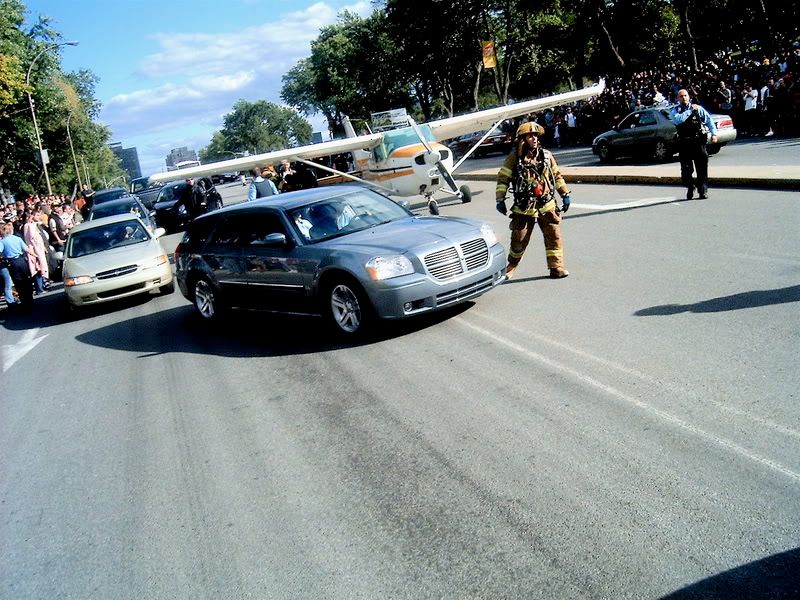
Yesterday, I was walking in downtown Montreal, and a plane landed in the middle of the street, just half a block behind me... And I didn't hear it. No shit.

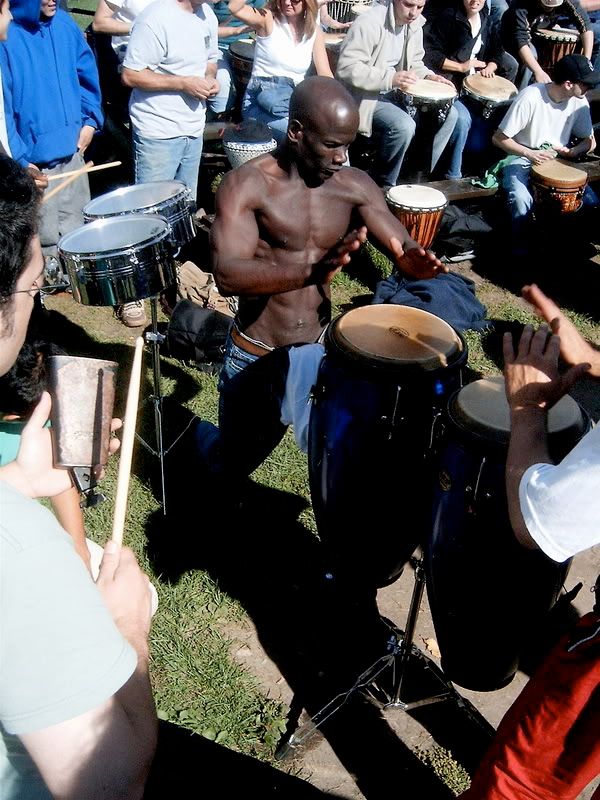
The day kicked off not unlike any other of my Sundays: Late breakfast, coffee. Meagan and I had walked down to what's referred to as Tam Tam; a weekly drum circle of sorts. The weather was having a bit of trouble making up its mind. After a few hours of throwing my hoodie back on every time the sun ducked behind a cloud, I suggested we make our way back east on Mont-Royal, offering to cook dinner and give her time to catch up on schoolwork. It was a quick affair: Tomato-basil penne with mock chicken. About the time I was finishing up eating, my phone began buzzing and sliding around the table. It was a 202 number.

The body of Jeff Mendez was moved from George Washington University Hospital less than twenty-four hours ago. Roughly a week prior, his Leukemia reappeared, and his doctors had him undergo chemotherapy immediately; compromising his immune system, allowing an infection to rip through his body like a flash flood. By the time I'd picked up the phone, he'd been unconscious for three days, and his family had gathered with friends to remove his life support. I had no idea he'd ever been sick. I spent the final hour of his life overcome by the urge to call him, buttressed by the knowledge he'd never hear it. Ever.

I've been on a train from Montreal for the last eleven hours, with another four to go. Around 1:30am, I'll make my way out of Union Station, walk the three blocks east to Stanton Park, then another four south to a client's house where Seager is dogsitting. I'll (hopefully) sleep a few hours, walk to Murky, find my way home, say hi to the cats, shower, and head out with Lance to the five hour memorial at the Palestine Center.

Later in the week, I'll borrow money from a friend to cover the train, and slip back across the border as though it were all just a bad dream, until I can make sense of a world in which Jeff Mendez is not alive.

Saturday, September 09, 2006

I'm not in this movie, I'm not in this song.

Montreal boasts an all-vegan Thai joint that, were it not for its stroke-inducing prices, would easily put Seattle's Araya to shame. Specializing in mock meats, they do an absolutely stellar job at replicating traditional, authentic Thai dishes that steer clear of being overly-fatty and greasy (a nice change of pace in terms of Asian food). Of course, what the food offers in the way of health is just as quickly cancelled out by what one's body suffers upon gandering at the bill. Jesus.

I met Helen a year ago at Renewing the Anarchist Tradition, where she gave a talk on growing older within movements, and considerations for building communities that both enable and support that project. It turned out to be one of the talks I most appreciated, and it spurred several hours of subsequent conversations with other attendees. Having cut my teeth with anarchism in the District, where youth is the discursive boundary that circumscribes what passes for self-idenitified anarchist politics, it was almost surreal hearing folks even have such conversations at an explicitly anarchist gathering, much less conversations that did not hinge on reaffirming one's loyalty to a specific set of aesthetics.

When my body dragged me across that frontier (admittedly, with an albeit clumsy willingness on my part), I took up spiritual residence among those I'd worked with around Palestine; a rabble of vibrantly diverse constitution (especially in age), far less inclined to police each other's lifestyles or force each other's increasingly square bodies through the round hole of perpetual adolescence. Certainly, there was a liberatory quality to that. But there were also moments in which I felt the chasm between myself and my own reconstructive vision inching wider; to the point that when several local infoshop characters were facing potential legal troubles over something typically stupid and irrelevant, I openly contested any obligation to them, dismissing the contention that they were somehow "my people" as fully lacking in evidence or coherence.

Being in Montreal, it seemed simply given that I'd catch up with IAS folks where possible, and despite our mutual scheduling conflicts, Helen was insistent that we at least grab dinner Friday night. I'd holed up in a cafe on Mont-Royal most of the day, futilely attempting to export an IAS database query that seemed to have been corrupted in a few recent updates. But by 7:30pm, I'd given up and we were strolling down Saint-Denis toward ChuChai. On the way, it struck me that I didn't really know her well. Beyond her presentation a year ago, the only time I'd spent with her was in the IAS board meeting in Boston, where I don't even recall us talking outside of the meeting itself. My subconscious kinda peeked out, reminding me that her nursing student schedule wasn't likely to afford time beyond dinner, a block I could easily fill up with banter specific to our work.

Helen had other ideas. Between dinner and the first fifteen minutes of the following day, we must've walked nearly the entire eastern half of the city, not to mention climbing the mountain at the center (in the dark), and finding our way back down. I don't recall any particular gaps in our conversation. What's more, I felt challenged in much of it; in both reflections on adjusting to dramatic disjunctures in day to day life, and reflections on the reincription of colonialist discourses undergirding certain threads of "queer" solidarity in Iran. Oddly enough, a certain part of me felt like an impostor at times, though mostly in that "Hold on a sec, I need to pinch myself real quick" sort of way.

Ultimately, I caught myself (here and there) giving way to the idea that it is, in fact, possible for me to be this person I wake up to each day; that there's hope he might begin to make some sort of sense in the reasonably near future.

Wednesday, September 06, 2006

I'm a city boy. Who knew?

While the charm of Montpelier is ample, given its status as the capitol of a state overrun by people sporting bumper stickers reading Vermont: Most Likely to Secede and US out of VT (see Second Vermont Republic), and the manner in which even the most apolitical Joe Schmoe is disdainful of even modest departures from face to face direct democracy... It's still little more than a small town. And after a month comprised largely of coffee, Nietzsche, instant-message marathons, The Shield, and low-brow cold sesame noodles... I've smuggled myself across our border with our younger, smarter cousin; landing in Montreal just in time to catch A Silver Mt. Zion's final tour date (which was nothing short of jaw-dropping).

There's an irony in my long journey to Canada: Until about 6pm EST yesterday, I'd spilled across the Western Hemisphere (not to mention a brief residency in the Middle East), without so much as ever setting foot in either of the countries bordering that of my origin. And I suppose it makes it that much better that my sleepless urban withdrawal is momentarily colliding with the European motif of my adolescent years, to the tune of utter elation. Languages melt into each other in mid-sentence, hemmed between structures half-Brooklyn/half-any-European City (take your pick); the character of the communities inhabiting them evident in ways that give the lie to the meanings my country has invested in "democracy." Less than twenty-four hours down, and I'm already dying for someone to tell me there's a dogwalking market here.

On the Metro last night, transferring from the Green to the Orange Line, I made my way over to a somewhat crowded bench. Preparing to unclip by messenger bag, I set down the copy of Jean-Francois Lyotard's The Postmodern Condition that I'd been reading since we set off from Montpelier. The guy sitting in the adjacent spot immediately picked it up, looked the cover over, and shot me an approving nod. I'm not sure why, but that sort of interaction registers with me as rare, to say the least (especially in the US); perhaps in part because we've grown resigned to a certain flavor of alienation, and in part because the range of ideas that enjoy that sort of broad currency in the US is shamefully narrow.

None of which is to romanticize my current surroundings as somehow utopian; given the work of a number of people dear to me, I know well exactly what (we'll say) imperfections lurk (and loom large) here. But it's a fairly jarring reminder that we can do better on our side of the border.

Monday, August 28, 2006

Right Guard will not help you here...

DC people, get your asses out to this. Seriously, the 92 bus stops about 4 times on 18th street (including a stop right across from Asylum). No excuses.

Rally at the Anacostia Public Library
Thursday, August 31, 2006
5:00pm to 7:30pm


Did you know that the Anacostia Library has been
shuttered since December 2004? Did you realize that
the Mayor and the City Council have never found it a
priority to make sure interim services are in place to
continue to serve the needs of this neighborhood?
Does this make you angry because you recognize the
important role libraries can play in a community?

TWO YEARS IS TOO LONG!!

Come on out to rally for the immediate reopening of
Anacostia Library and bring your friends and
children...

* Keynote speakers

* Children's activities and reading-time

* Food and beverages will be served

* Open mic for ALL - step up to the podium and speak!


WHERE:
Anacostia Public Library
1800 Good Hope Road, SE (18th & Good Hope)
(the 92 bus stops directly in front of the library)

WHEN:
Thursday, August, 31, 5:00 to 7:30pm

**

VOLUNTEER
We are looking for organizing assistance as well. Can
you help spread the word by email, flyer? Can you help
read books to kids or do you have a car? Contact >>
Robin Diener, 202-387-8030,
rdiener@savedclibraries.org